LLM Chatbots vs AI Agents: Know the Difference
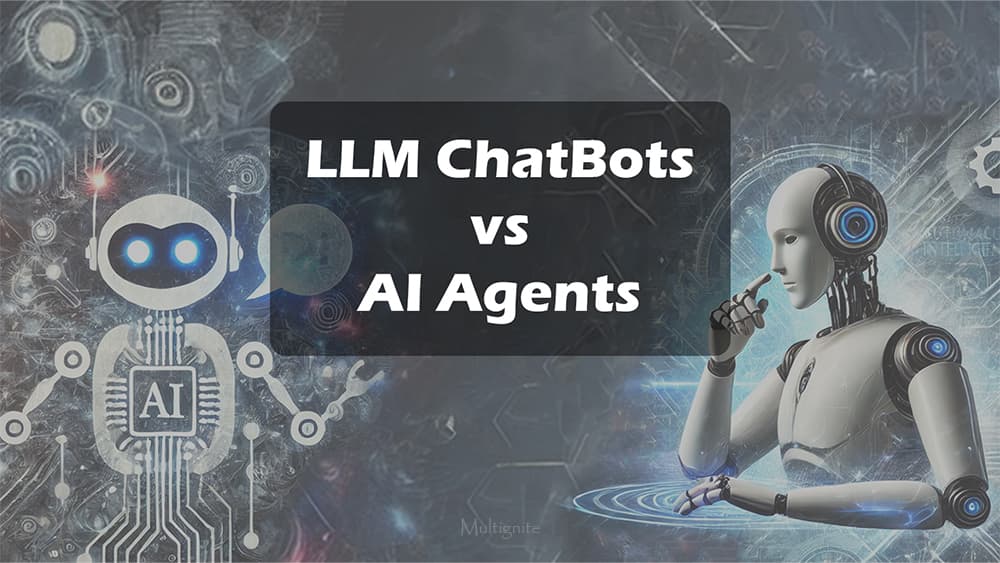
In the world of artificial intelligence, the terms LLM chatbots and AI agents are often used interchangeably, leading to confusion. However, they are fundamentally different in their design, purpose, and capabilities. While both leverage AI technologies, understanding their distinctions is crucial to using them effectively.
What Are LLM Chatbots?
LLM chatbots are conversational AI systems powered by large language models (LLMs), such asOpenAI's ChatGPT, Google’s Gemini, Claude AI and more. They are designed to process and generate natural language, enabling them to engage in human-like conversations, answer questions, and provide insights based on their training data.
Examples of LLM Chatbots:
ChatGPT
Google Gemini
Claude AI
Perplexity AI
Microsoft Copilot
Meta's LLaMA-powered Bots
YouChat
Key Features of LLM Chatbots:
Conversational Specialists: Designed primarily for dialogue-based interactions.
Reactive Behavior: Respond to user prompts but lack autonomy or independent decision-making.
Text-Centric Functionality: Limited to tasks involving understanding or generating text.
Use Case Examples:
Customer support bots that help users troubleshoot common issues.
Tools for drafting emails, articles, or creative content.
Educational companions for learning new topics interactively.
What Are AI Agents?
AI agents are systems designed to perform tasks autonomously. They combine various AI capabilities, including LLMs, to not only understand inputs but also make decisions and take actions based on specific goals or objectives. Unlike chatbots, they are proactive and task-oriented.
Examples of AI Agents:
AutoGPT
AgentGPT
LangChain Agents
Zapier AI Agents
GitHub Copilot for Pull Requests
AWS DevOps Guru
Datadog AI
Kustomer IQ
Drift Conversational Sales AI
Cleo AI
Key Features of AI Agents:
Autonomy: Operate independently, making decisions without constant user input.
Goal-Oriented: Focused on completing specific tasks or solving problems.
Integration Capabilities: Often work with external tools, APIs, or environments to achieve objectives.
Adaptive Learning: Some agents improve their performance through reinforcement learning or continuous updates.
Use Case Examples:
Personal assistants that manage calendars, book appointments, and send reminders.
DevOps tools that monitor system performance and automatically resolve issues.
Research agents that gather data, analyze it, and deliver actionable insights.
Comparing LLM Chatbots and AI Agents
| Feature | LLM Chatbots | AI Agents |
|---|---|---|
| Primary Role | Conversation and text generation | Task automation and autonomous actions |
| Autonomy | Reactive (responds to prompts) | Autonomous (acts independently) |
| Scope | Limited to understanding/generating text | Broader, task-oriented goals |
| Tool Integration | Rare, unless explicitly connected | Extensive, often uses external tools |
| Examples | ChatGPT, Clause AI, Google Gemini | AutoGPT, LangChain agents, virtual assistants |
Why the Confusion?
The confusion arises because AI agents often incorporate LLMs as a component of their systems. For instance, an AI agent might use an LLM to interpret user intent ("Book me a flight to Paris") while relying on APIs to search for tickets and make the reservation autonomously.
In contrast, an LLM chatbot like ChatGPT is primarily a conversational interface. It can assist with information or ideas but won’t independently perform actions unless explicitly programmed to do so.
When to Use What?
Choose LLM Chatbots If:
You need conversational AI for answering questions or generating text.
Your focus is on interaction, not task execution.
Choose AI Agents If:
You require autonomous systems to complete tasks or automate workflows.
You need AI that integrates with tools or APIs to perform complex actions.
Understanding the Difference
While AI agents and LLM chatbots may seem similar at first glance, they serve distinct purposes. Chatbots excel at natural language interactions, while AI agents are built for autonomy and task execution. Knowing the difference empowers you to make informed decisions and leverage these technologies effectively.
What’s your experience with AI agents or LLM chatbots? Let’s discuss in the comments below!